
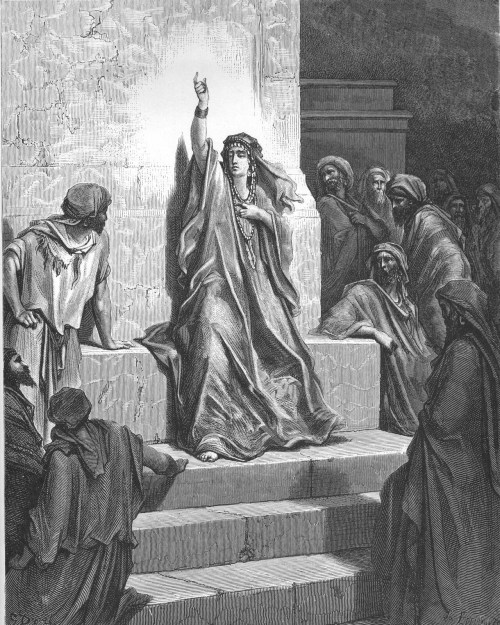
Deborah Praises Jael, Gustav Doré. Source: Wikimedia Commons.
Deborah is one of five female prophets in the Hebrew Bible, along with Miriam, sister of Moses and Aaron; Huldah, who prophesies the end of Israel’s time in Canaan; the unnamed wife of Isaiah the prophet; and Noadiah, who appears during the restoration from exile.
In Brief
Deborah is one of the major judges (charismatic military leaders, not juridical figures) in the story of how Israel takes the land of Canaan. She is the only female judge, the only one to be called a prophet, and the only one described as performing a judicial function.
Deborah summons Barak to lead the battle against the Canaanites; he agrees, but only if she accompanies him. Barak and his warriors destroy all the Canaanites except Sisera, who seeks refuge with but is killed by Jael.
Place in Biblical Texts
Deborah is one of the major judges (meaning charismatic military leaders, rather than juridical figures) in the Book of Judges’ story of how Israel takes the land of Canaan.
The only female judge, the only one to be called a prophet, and the only one described as performing a judicial function, Deborah is a decisive figure in the defeat of the Canaanites. This is a victory told in two accounts, a prose narrative in Judges 4 and a poem, known as the Song of Deborah, in Judges 5.
Deborah’s Identity
As the story opens in Judges 4, Deborah is already a judge, settling disputes brought to her while she sits under the “palm of Deborah” in the hill country of Ephraim (4:5). She is identified as eshet lappidot (4:4), which may mean “woman of [the town] Lappidoth,” “wife of [the man] Lappidoth,” or “woman of torches” (that is, “fiery woman” or even “pyromancer”). If Lappidoth is a person, he is an otherwise unknown figure in the Hebrew Bible.
Most of the judges are acknowledged as such after military victory; Deborah is called a judge before the battle, but the narrative does not include the story of how she became a judge, why she is called a “prophetess,” or the way in which God commanded her to begin the battle against Jabin, the Canaanite king of Hazor, and his general, Sisera. All other judges in the book appear to be military leaders, so we can assume Deborah is as well. The text does not describe her actually wielding weapons, though it also does not mention Barak doing so, and interpreters uniformly assume he did.
Deborah and Barak vs. Sisera
Deborah summons Barak to be her general (4:6), relaying God’s command to take ten thousand men to Mount Tabor to begin the battle. When he responds that he will go only if she will, she agrees to go but informs Barak that he will get no glory from the victory, for “the Lord will deliver [NRSV, sell] Sisera into the hand of a woman” (4:9). This pronouncement is meant in part to shame Barak for his apparent cowardice: because he will not readily “man up,” a woman will get the credit for taking down the enemy general. The reader naturally assumes that the woman will be Deborah.
Sisera deploys his army against Deborah, Barak, and the troops near Mount Tabor in Galilee. Deborah announces to Barak that the day of victory has come, and “the Lord is indeed going out before you.” Barak and his warriors destroy all the Canaanites except Sisera, who flees from the battle and seeks refuge with a woman, Jael, who kills him.
The Song of Deborah, preserved in Judges 5, tells more about this final battle. It describes the chaotic conditions that exist until “I [some translations: you] arose, Deborah,/arose as a mother in Israel” (5:7). In the poetic version of events, YHWH takes part in the actual battle, causing a sudden flood: “The stars fought from heaven,/from their courses they fought against Sisera./The torrent Kishon swept them away” (5:21). This disabled the Canaanite chariots, enabling Israel’s infantry to win.
The Song of Deborah concludes with a heroic depiction of Jael as a woman warrior and with a taunt of Sisera’s mother, waiting anxiously and in vain for Sisera to return after the battle. As the speaker, Deborah does not show sympathy toward Sisera’s mother. Quite the contrary—she portrays her as the quintessential enemy woman, already anticipating the riches that the fighters will bring as spoil when they return. These riches would include both materia1 wealth and captive women—“a womb or two for each man’s head” (5:30). As narrator, Deborah’s rendering of the enemy women’s thoughts is crude, reducing the anticipated human spoils of war to their anatomical utility. The battle is between Israelites and Canaanites, and each set of women aligns solidly with its own group.
Protector of Israel
Deborah is called, or calls herself, a “mother in Israel.” (Judg 5:7). Perhaps the character is meant to be a biological mother, but no children are mentioned in the text. More likely, the phrase indicates that her arbitration powers as judge were parental, even maternal—though hardly in a tender, nurturing sense. “Mother,” like “father,” can be an honorific title for an authority figure or protector in the community (compare 1 Sam 24:1 and Isa 22:21). We can also read Deborah’s proclaimed status as a mother as a way of blunting the shock of her transgressive, violent character. Deborah is described with motherhood language, despite the lack of children in her story, as a way of making her seem less threatening.
As a respected politico-judicial authority, Deborah has a counterpart in the wise woman of Abel, who speaks for and rescues the city of Abel where, she says, the people of Israel bring their disputes to be settled (2 Sam 20:15–22). As a singer of victory songs, she echoes Miriam and foreshadows latter women who celebrate David’s military success (1 Sam 18:6–7).
Categories: Articole de interes general
Related Articles
-
 Ești bătrân dacă …
-
 CNN ajunge sub controlul familiei Ellison, apropiată de Donald Trump. Va mai fi CNN o trompeta neomarxista? Dar Antena 3? | SACCSIV – blog ortodox
-
 Cristela Georgescu, interviu exploziv, cu lacrimi în ochi, la Alex Jones. Celebrul realizator american: ”Cu toții suntem Călin Georgescu! Globaliștii vor sfârși ca Ceaușescu dacă nu se opresc” – VIDEO ACTUALIZARE CU TRANSCRIERE. Ziua 11 la Arestul Central | ActiveNews


Leave a Reply