
INTEZIS DOGMATICILOR !!! (și celor superficiali, sugarilor duhovnicești)
 Există subiecte pe care nu le putem aborda de la amvon? Bineînțeles! Iată unul.
Este una din problemele care-ți fac părul creț sau te duc la chelie, de atâta scărpinat în cap !
O fi importantă? N-o fi? Eu vi-o scriu!
7 ,,Adu-ţi aminte de zilele din vechime,
Socoteşte anii, vârstă de oameni după vârstă de oameni,
Întreabă pe tatăl tău, şi te va învăţa,
Pe bătrânii tăi, şi îţi vor spune.8 Când Cel Preaînalt a dat o moştenire neamurilor,
Când a despărţit pe copiii oamenilor,
A pus hotare popoarelor
După numărul copiilor lui Israel,
9 Căci partea Domnului este poporul Lui,
Iacov este partea Lui de moştenire.
,,Trimiterile“ așezate de cei care au studiat Biblia mult înaintea noastră și ne-au adăugat la textul inspirat o ,,mică concordanță“ a lor, mărturisesc caracterul obscur al afirmației din text.
Există unii care susțin că ,,popoarele“ au fost repartizate unor ,,îngeri“ administratori (părere întemeiată pe ceea ce spune profetul Daniel despre căpeteniile angelice identificate cu popoare și imperii (Daniel 10 – 12 ,,angelic prince of Persia (10.13,20), a prince of Greece (10.20), and Michael the prince of Israel (10.13,21; 12.1).
Există alții care susțin osimetrie a împărțirii popoarelor și numărul copiilor lui Dumnezeu din listele de neam din cartea Genezei.
John MacArthur:
Numele folosit aici pentru Dumnezeu (,,Cel Prea Înalt“) subliniază suveranitatea și autoritatea Lui asupra tuturor popoarelor (vezi Gen. 11:9; 10:32; 14:18; Num. 24:16), cu precizarea extraordinară că în tot planul lui Dumnezeu cu lumea, scopul final este salvarea poporului Său ales. Dumnezeu a prestabilit un plan în care există această simetrie: numărul popoarelor (70 conform textului din Geneza 10) corespunde cu numărul copiilor lui Israel (70 conform textului din Geneza 46:27). Mai mult, când le-a dat țări popoarelor și a stabilit hotarele diferitelor națiuni, Dumnezeu a vegheat să lase suficient pământ ca să susțină numărul de populație pe care El a anticipat-o pentru evrei.
Pentru cei ce puteți citi în limba engleză, iată puțin din frâmântările hermeneuților (aici):
4QDeutj“When Elyon gave the nations as an inheritance, when he separated the sons of man, he set the boundaries of the peoples according to the number of the sons of God (bny ‘l[hym]). For Yahweh’s portion was his people; Jacob was the lot of his inheritance”.
LXX“When the Most High divided the nations, when he separated the sons of Adam, he set the boundaries of the nations according to the number of the angels of God (aggelón theou). And his people Jacob became the portion of the Lord, Israel was the line of his inheritance”.
MT“When Elyon gave the nations their inheritance, when he divided all the sons of man, he set the boundaries of the peoples according to the number of the sons of Israel (bny yshr’l). For Yahweh’s portion was his people, Jacob was the lot of his inheritance”.
Which one is the correct one?Why the differences?Notice that bny el is similar to bny yshr’l. However, how does that become aggelon theou (angels of god)? This seems to be quite far-fetched.Another version talks about sons of Bull El instead of sons of El:When Elyon gave the nations an inheritance, when he divided humankind, he set the bounds of the peoples according to the number of Bull El’s children, and Yahweh’s portion was his people, Jacob, the lot of his inheritance.
http://ancienthebrewpoetry.typepad.com/ancient_hebrew_poetry/2008/04/elyon-bull-el-a.html(Who is Bull El? Is it related to the golden calf the Israelites built?)


|
|
If masoretic texts are indeed accurate, how come septuagint translate that into angels of God? It’s quite unlikely that sons of Israel translate to angels of God. What’s quite likely is the original text says sons of God. Whatever source LXX uses must be something that translate into angels of God. – Jim Thio Jan 3 ’14 at 10:57
|
|
My answer here will borrow from an essay by Michael Heiser (who I see left a comment on the page you linked to): Variants in Deuteronomy 32.8-9Sons of Israel
Angels of God
Sons of God
Just from the evidence for Deuteronomy 32.8-9, the ‘sons of God’ variant seems the most well-attested, being represented by the widest array of independent manuscript traditions. Another Variant in Deuteronomy 32.43After surveying hypothetical explanations of how the variants emerged, Heiser points us to another textual variant in Deuteronomy 32.43; this verse has three variants, again divided between the MT, DSS, and LXX versions. The text in question is made out of bicolons, which are poetic lines that come in pairs, e.g. ‘the sea looked and fled | the Jordan turned back’ is a bicolon. The longest variant of Deuteronomy 32.43 is the LXX, which consists of four bicolons:
The DSS is the same as the LXX, but is missing the second bicolon, and has slightly shorter versions of the third and fourth bicolons:
The MT is missing the first bicolon entirely, the second and fourth bicolons are half-missing, and the third bicolon changes ‘sons’ to ‘servants’.
Summary of the Deuteronomy EvidenceThe LXX of Deuteronomy 32.8-9 and 32.43 both include references to ‘sons of God’ or ‘angels of God’. The DSS of Deuteronomy 32.8-9 and 32.43 both include references to ‘sons of God’ or ‘gods’. The MT of Deuteronomy 32.8-9 instead refers to ‘sons of Israel’, and 32.43 completely lacks references to ‘sons of God’, ‘angels of God’, or ‘gods’. While the LXX and the DSS are not identical, they still agree that the original reading of Deuteronomy 32.8-9 read ‘sons of God’. The MT represents a minority variant of Deuteronomy 32.8-9, that was probably altered intentionally to ‘”protect God” or correct theology’, that is, it was altered intentionally to remove references to divine beings other than YHWH. This is supported by the MT’s more overt alterations to Deuteronomy 32.43, where again the LXX and DSS largely agree that it referenced divine beings. Altogether, the manuscript evidence for Deuteronomy 32 supports the conclusion that ‘sons of God’ is the original text of 32.8-9. The ‘Bull El’ reading mentioned has a major weakness, in that it is an entirely hypothetical reconstruction, found in no existing variants. (As for 32.43, Heiser implies via Tigay, one of his sources, that the DSS variant represents the closet form to the original text, with the LXX having added material, and the MT having removed and altered material.) Circumstantial Supporting EvidenceDaniel 10-12 contains an unusual feature, in that it suggests the nations of the earth correspond to angelic figures. These chapters specifically refer to an angelic prince of Persia (10.13,20), a prince of Greece (10.20), and Michael the prince of Israel (10.13,21; 12.1). The book of Daniel displays an obvious familiarity with an existing ‘Law of Moses’ (9.11,13), so it may be the author’s concept that nations correspond to angels comes from the ‘sons of God’ reading of Deuteronomy 32.8-9. ResourceMichael S. Heiser, Deuteronomy 32:8 and the Sons of God (2001). |
||||
Pentru cei pasionați, ca și mine, de aceste lucruri, vă îndemn să parcurgeți un material extrem de interesant (aici), din care citez aiici doar începutul:
Saturday, July 6, 2013
The gods of Deut. 32:8: An Israelite Pantheon?
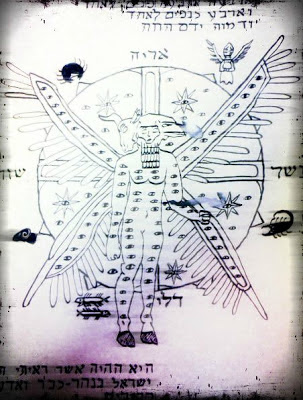 |
| An artistic iconographic harmonization of my own. The divine beings of Israel’s religion share many of the titles, iconography and functions employed by their surrounding neighbors |
At the end of my last post (which should be read before this one), I complained that the majority of critical scholarship since the late 19th century has seen in the scriptures a chronological evolution of Israel’s religion from polytheism to monotheism. Critics attempt to demonstrate this evolution by pointing to early Biblical texts which speak of the existence of multiple gods.[1] These “polytheistic” texts are then contrasted with the standard monotheistic declarations in later post–exilic texts those sweet old ladies in hats had you recite since Sunday school. There you have it. Israelite monotheism must have evolved under Hezekiah.
For example, a “polytheistic” text like Psalm 138:1 might be contrasted with a “contradictory” later-developed “monotheistic” text like Deut 4:39:
“I will praise you with my whole heart: before the gods will I sing praise to you.” “…Yahweh, he is the God in heaven above and on the earth beneath; there is no other”
Traditionally evangelicals counter the reconstruction described above by doing their best to demythologize the texts in the Bible which affirm the existence of multiple gods. They assure us: “Those aren’t gods. Those are human rulers that the OT calls gods!”
Evangelicals are losing the debate and we deserve to. Exegetically, the evangelical response has been as elegant as a shaved gorilla. In short, I believe it’s driven by 17th century terminology which is detached from the ANE material. At the same time, critical scholarship is wrong because it misinterprets post-exilic texts to contrive a strict post-exilic monotheism. Since both the critical scylla and evangelical charybdis are deficient, a third way between them has been entertained by several fed-up scholars. As I stated in my last post, I don’t believe that third way implies contradiction in the Bible or in anyway effaces our fidelity to monotheism. More importantly, it was the worldview of the Biblical authors and Jesus. Understanding this is a healthy invitation for Christians to re-embrace the highly supernatural worldview of scripture. …
…. (continuare)
Categories: Studiu biblic, Teologice
 Taina Templului evreiesc
  Barzilaiendan
Ai dreptate. Am corectat. Multumesc frumos.
pare-mi-se ca ati gresit capitolul din titlu…trebuia capitolul 32, nu-i asa? 🙂