
I was raised Roman Catholic for the first nineteen years of my life, and I have lived as a Protestant for the past fifty-three. Over that time, I have served as a layman, as a deacon, and now as a pastor within Baptist churches shaped by Evangelical Reformed theology. For that reason, the version of Protestantism described by many Catholics on X does not correspond to anything I have known in doctrine or in practice.
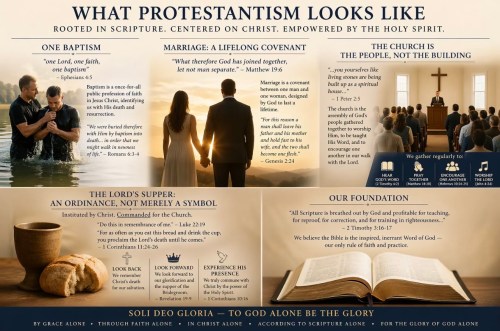
Protestants do not approach baptism casually, as if it were something to be repeated at will. Scripture speaks clearly of “one Lord, one faith, one baptism” (Eph 4:5). Baptism marks entry into the covenant community as a public profession of faith, grounded in union with Christ in his death and resurrection (Rom 6:3–4). It is not a ritual to be multiplied, but a once-for-all sign of that union.
In the same way, Protestants take marriage with full seriousness as a covenant before God. From the beginning, “a man shall leave his father and his mother and hold fast to his wife, and they shall become one flesh” (Gen 2:24; cf. Matt 19:4–6). What God has joined together is not to be treated lightly or dissolved according to preference. Our teaching and pastoral practice aim to uphold that lifelong covenant, even as we carefully work through the difficult pastoral cases addressed in passages such as Matt 19 and 1 Cor 7.
Protestants also do not understand the church as a building. Scripture consistently speaks of the church as the gathered people of God: “you yourselves like living stones are being built up as a spiritual house” (1 Pet 2:5). The church is the assembly (ekklēsia) of those called out and joined together in Christ (Heb 10:24–25), who meet regularly for worship, for the preaching of the Word (2 Tim 4:2), for prayer, and for mutual encouragement as we persevere in faith.
With respect to the Lord’s Supper, Protestants do not treat it as a mere symbol devoid of spiritual reality. It is an ordinance instituted by Christ—“Do this in remembrance of me” (Luke 22:19; 1 Cor 11:24–25)—in which we proclaim his death until he comes (1 Cor 11:26). In that act, we look back to the cross, we examine ourselves in the present (1 Cor 11:28), and we look forward to the marriage supper of the Lamb (Rev 19:9). And while we deny any change in the elements themselves, we affirm that believers truly commune with Christ by the Spirit. As Paul writes, “The cup of blessing that we bless, is it not a participation in the blood of Christ?” (1 Cor 10:16). The presence we experience is not physical, but it is real—mediated by the Holy Spirit and received by faith.
I could continue, but the point is straightforward. The Protestantism I see described by Catholics is not one I recognize from Scripture, from church history, or from a lifetime within Evangelical Reformed Baptist life. It bears little resemblance to the convictions that have shaped my faith, my ministry, and the churches I have served.
Ryan Burge:
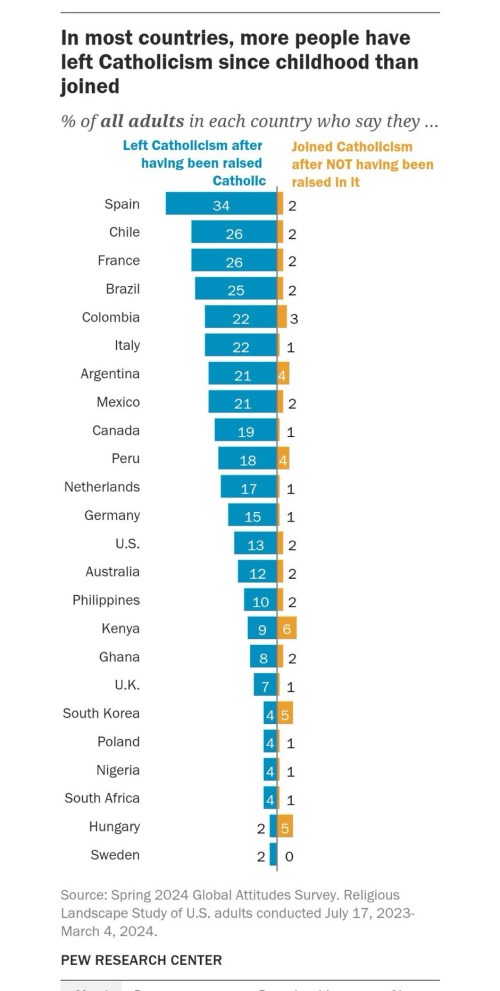
Catholicism is losing a lot more people than it’s gaining through conversion.
That’s true in the United States but it’s also true in many of the most historically Catholic countries in the world.
In France, the ratio is 13:1
It’s 7.5:1 in the US.
From Pew:
Categories: Articole de interes general
 Report: Expats Who Fled to Europe Because of Trump Regret the Move

Leave a Reply