
Vă ofer un articol în care elementele tradiționale evreiești ale ,,Seder“-ului sunt îmbinate cu semnificațiile noi ale Cinei cele de Taină.
(Roehl, Tim (2010-02-11). The Day That Changed Forever: Twenty-One Life-Changing Experiences at the Cross (Kindle Locations 586-614). Baker Publishing Group. Kindle Edition.)
JOHN 13: 1-30
Night was coming. Jerusalem was swollen with tens of thousands of pilgrims assembled to celebrate the Passover feast. Most had settled in for the night, but there were those who rested uneasy, sensing a gathering storm, unseen but nonetheless real. The night sky was clear, but the darkness was heavy and close. Dogs looked upward, then cowered, whining softly as they sensed things unable to be heard by human ears. Those with hearts tuned to the Spirit of God listened intently and began to pray, heeding a call to intercede intensely.
Time was moving toward its close . . . and its beginning . . . arriving at a date with destiny that would forever mark recorded history. In an upper room in one of the many stone houses in the city, a group of men were gathered in heavy-hearted silence.
They had been that way all day— moody, grouchy, overly sensitive. An argument had broken out among them when the mother of James and John had the audacity to ask Jesus if her two sons could have the seats of authority on His right and left hand when He took His kingdom throne. Jesus’ response was grim. He told her that she had no idea what she was asking . . . no idea what the price would be for Him to return to His throne and His home in heaven.
The incident had set them off. Unspoken agendas and unholy attitudes came to the surface as unseemly behavior— scowling and sniping at each other as outward evidences of anger boiling just under the surface.
Jesus had surprised them by saying He had arranged for the Passover meal. They were to look for a man carrying a water pot— odd, because that was a woman’s job— and follow the man to the appointed place. They were so wrapped up in their own feelings that they were oblivious to the heart of their Teacher and His own needs.
This was Jesus’ last night on earth. He had looked forward to this night with the twelve men He had chosen three years ago— to be with Him, to learn from Him, to minister with Him, to carry on His work when His mission was done. These were His disciples, His chosen friends, His intimate companions. This meal was to become far more than a normal Passover feast . . . it was His last supper with them and the beginning of a new way to remember His sacrifice for all time to come.
If ever Jesus needed His men to support Him, it was now. Unfortunately, the disciples were preoccupied with their squabbling. As they entered the room, each man looked away from a clay pot of water standing near the door. They all knew it was there; similar jars stood by nearly every door in every home in Israel. What they didn’t want to acknowledge was what the jar of water stood for, because it beckoned them to humility and servanthood. Almost all travel was by foot over dusty roads, and the footwear of the day was open sandals; so walking was a dirty, dusty endeavor. As guests entered a home, it was the job of a servant to wash the travel grit off of the feet of all who entered the home. It was a menial, dirty job that only a lowly servant would do. To enter a home with un-washed feet was beyond impolite; it was downright rude. However, at this Passover supper there was no servant to wash their feet, and no one wanted to take on such a role, especially when they had all been arguing and jockeying for positions of power.
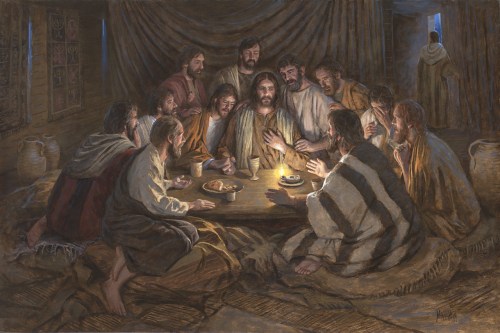
As they gathered around the low table, reclining on their left sides so they could eat with their right hands, they stretched out their robes to cover their feet— trying to pretend nothing was wrong when, in fact, everything was. They looked toward the table, low to the ground and U-shaped so that three could recline at the bottom of the U and up to five could recline on either spur. Even now they were edgy about who got to sit where, since where you sat in social settings said a lot about who you were in terms of status and significance. Still scowling at each other, they silently jockeyed for the best positions around the table.
Jesus shook His head as He watched them. He let them finally find their places at the table and whispered to Judas to take the place to His left, a place reserved for someone special. If the disciples had looked closely, they would have seen the strain of His impending trial and death weighing on Him; they would have seen His knowing look of disappointment over their immature squabbling; they would have seen His love for them overcoming all else. But they were unwilling to look at each other or look up at Jesus . . . or at the water pot by the door, which seemed to grow larger and more imposing by the minute. For a long moment no one said anything in the heavy silence. They hoped no one would notice, and the Passover meal could begin, dirty feet and all.
The Passover meal was a central tradition in their spiritual life as a nation. It was a yearly event so important that children began memorizing each part of the ceremony, every passage of Scripture, emphasizing the historical and spiritual essentials for them to remember.
The Passover meal was called the Seder, meaning to “set order,” because there was a distinct order to everything they did— 15 consecutive steps constituted a full Seder. They knew the steps by heart, even if at this moment their hearts were not in it. There were several vital elements to the meal, including the Feast of Unleavened Bread, which had started days before.
The Feast of Unleavened Bread brought them back to some powerful historical lessons from God’s deliverance of their nation from slavery in Egypt, and some important spiritual directives to help them be free from sin now. Yeast was a sign of the contamination that sin brought to a person’s life. Even a little leavening (a little yeast) would soon work its influence in the rest of the bread, just as a little sin would soon infect the whole of a person’s life. When they’d left Egypt, the Lord had commanded them to eat and bring only unleavened bread with them. Any connection to the corrupting influence of the bondage of sin in Egypt was to be left behind.
The present-day equivalent was to cleanse their homes from every vestige of leaven to signify a clean break from the past and a fresh start free from contamination. The obvious inference was that people would ask the Lord to cleanse their hearts from the selfishness of sin in the same way. With that cleansing of house and heart in mind, the other components of the Seder were to both remind and release other spiritual lessons.
The lamb was to remind them of how the blood of spotless lambs smeared over the Israelites’ doorposts had protected them from the Angel of Death; that blood was their salvation as judgment passed over them. Every person had to sacrifice his own lamb at the Temple as a reminder of the intensely personal nature of sin and its consequences.
After the blood was captured by the priest, the lamb was prepared for roasting over a fire at home. The lamb had a wooden spit running through its mouth on one end and the tail at the other, with another stick against the ribs to prop it open. The two wooden pieces formed a cross.
The unleavened bread was to remind them of the haste in which they left slavery behind on that first exodus from Egypt.
The bowl of salt water was to remind them of the tears shed as slaves in Egypt and the waters of the Red Sea, which God had parted for them so they could cross safely on dry ground and walk toward the Promised Land.
The bitter herbs of horseradish and lettuce were to be eaten with the unleavened bread to remind them of the bitter taste that slavery left in their mouths.
The Charoset paste— a brown mush made of apples, dates, pomegranates and cinnamon— was to remind them of the clay from which they made bricks in Egypt.
Four cups of wine, drunk at different parts of the Feast, each represented the redemption promise of Yahweh their Deliverer, recorded in Exodus 6: 6-7. Together the four cups were called the Cup of Salvation.
“I will bring you out from under the burdens of the Egyptians.”

The First Cup of Holiness represented separation from sin, and sanctification or purification of heart. “I will rescue you from their bondage.”
The Second Cup of Explaining or Proclaiming told the great story of God’s deliverance and was rehearsed for young and old alike.
“I will redeem you . . .” This was the Third Cup of Redemption and Thanksgiving.
“I will take you as my people and I will be your God.” This was the Fourth Cup of Completion and Commitment.
The Master of the Meal would begin by lifting the First Cup and proclaiming a blessing. Jesus took the first cup and tenderly looked around the table at His men. They’d been with Him for three years. He’d poured Himself into them, showing them by His own life what life was supposed to be like for them. He said, “I have deeply desired to eat this Passover with you before I suffer. I tell you . . . I won’t eat it again until what this means is fulfilled in the Kingdom of God.”
He lifted it up with both hands and began the familiar words . . .
“Blessed are You, Lord our God, King of the Universe, who creates the fruit of the vine . . . Blessed are You, Lord our God, King of the Universe, who has chosen us from among all nations, exalted us above all tongues, and sanctified us with His commandments. With love You have given us, O Lord our God, appointed times for gladness, festivals and seasons for rejoicing, this Feast of Unleavened Bread, the season of our deliverance, with love, a sacred rehearsal in remembrance of the departure from Egypt. For You have chosen us, and You have sanctified us from all the nations, and You have given us festivals with gladness as our heritage. Blessed are You, Lord our God, who sanctifies Israel and the seasons . . .”
These were the familiar, sacred words spoken just as they were supposed to be, and the disciples responded as they had been taught:
“Blessed are You, Lord our God, King of the Universe, who has kept us alive, sustained us and brought us to this season.”
With those familiar words, the tension eased a bit. Perhaps the debacle of the dirty feet had been forgotten.
The next Seder step was the washing of the hands by the host. Three times, in a prescribed way, the water was used to cleanse the host’s hands as he prepared to have the rest of the meal served. It was at that point that Jesus went completely off script and taught them one of the life lessons of the Upper Room they would never forget.
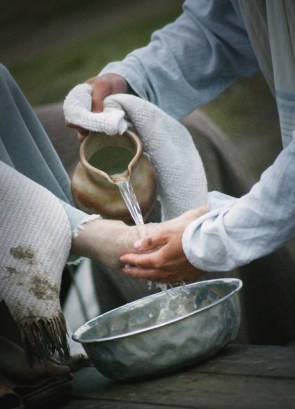
Jesus walked over to the doorway, took off His outer garment and wrapped a towel around His waist, then poured water into a basin. Carrying the basin over to the table, Jesus knelt before His men and began to do the thing no one else wanted to do. He began to wash the disciples’ feet, and He did it because He was the Son of God. He started with Peter, who was at one end of the U. When Peter saw Jesus kneel in front of him, he drew his feet even further under his robe, his eyes flashing protest and embarrassment.
“Lord, You’re not going to wash my feet, are You?” They all knew it was forbidden to force a servant to do the lowly job of washing his master’s feet . . . and here the master wanted to wash his feet! Jesus looked up and smiled as He continued to pour water into the basin. “Peter, you don’t understand what I’m doing right now, but someday you will.” Peter shook his head emphatically and said, “No! You’ll never wash my feet! You’re the Master . . . the host . . . this just isn’t done! Someone of Your stature should never stoop to such a thing! I’ll never let You do it!” This time Jesus met Peter’s eyes and held them, his expression sad but steady.
“Peter, if you don’t let me wash you, you have no part with me— you’ll not belong to me.” Suddenly Peter realized that Jesus was talking about more than dusty feet. He’d exposed Peter’s dirty motives. Beneath that feigned humility was a desire to be first, to stand out. If following the way of Jesus meant relinquishing that drive to stand above the rest, then his dedication to a self-first desire had just led to a parting of the ways.
Dirty feet weren’t the point; a divided heart was the issue. It was a matter of inner holiness, not outer hygiene, and that issue made all the difference between belonging to Jesus or not.
When Peter realized what was really going on, his eyes welled up with tears at the thought of what he’d almost done. He threw back his robe and thrust his feet forward, leaning forward to show the top of his balding head at the same time. “Then, please,” he said meekly, fervently, “don’t wash only my feet, Lord. Wash my hands and head too.”
The invitation flowed from his desperation for total interior cleansing, not just a partial, outward ritual. Jesus took the towel, soaked it with water and playfully rubbed the top of Peter’s head. Smiles around the room acknowledged their understanding and assent. They, too, wanted what Peter had asked for.
Jesus said, “A person who has been fully cleansed doesn’t need to take a complete bath again. He just needs to make sure he frequently washes off the dirt of the outside world. And you are clean . . .” Jesus paused, glancing toward the head of the table where Judas reclined. “But that isn’t true of everyone here.” With that, He finished washing the now humble Peter’s feet.
Jesus knelt before each beloved disciple, one by one, and washed each man’s feet. The room was silent except for the splashing and sloshing of water as a towel was squeezed, scrubbed and soaked . . . squeezed, scrubbed and soaked. These were sacred moments.
Once again Jesus had turned conventional wisdom and tradition on its head and made everyone focus on the central issue of the condition of the heart. They’d seen Him do it so many times over the three years they had been with Him. He never violated any of God’s laws, but always reminded them of what the spirit of those laws was really all about: mercy over rigidity; forgiveness over form; relationship over ritual; the internal over the external; holy love over hard-line law. He washed every foot, seeming to take extra care with Judas’s.
Then He threw out the dirty water, hung the towel back on its peg and replaced the basin. He put on His robe and returned to the table to recline again. He looked around the room, each disciple leaning forward in anticipation. The unbroken tradition of the Seder had been changed; a new way had begun.
There was a hint of urgency in Jesus’ voice as He said, “Do you understand what I’ve done for you? You call me ‘Teacher’ and ‘Lord,’ and you are right . . . that’s who I am. And since I am your teacher and Lord, and I have washed your feet, you ought to wash each other’s feet. I have given you an example to follow. Do for others what I’ve done for you. It is true that a servant is not greater than the master. Nor are messengers more important than the one who sends the message. You know these things— now do them! That is the path of blessing.”
A look of sadness came to His face, and for a moment the Lord appeared to weigh His words carefully.
“I am not saying these things to all of you; I know each of you that I’ve chosen so well. The Scriptures say, ‘The one who shares my food has raised his heel against me . . . he’s turned against me.’ This will come true tonight. But I’m telling you all this now so that when it happens you’ll remember and believe that I really am the Messiah. The truth is that anyone who welcomes my messenger is welcoming me; and anyone who welcomes me is welcoming the Father who sent me.”
It looked like His great heart was about to break with anguish and sorrow when He said . . . “One of you is going to betray me.”
For an instant, they were stunned; things had turned from sacred to shocking in a sentence. Their response was instinctive and explosive. Angry, surprised, bewildered, protective . . . they didn’t know what to feel or quite what to say. They all talked over the top of each other, asking the same question out loud and the same question in their minds. “Lord, it’s not me, is it?” “Who is it? We’re going to kill him!”
Around and across the table they continued to question Him vehemently, but Jesus was silent. It was obvious that He knew who the traitor was, and He wasn’t telling. Why wouldn’t He let them do something? All it took was one word, but Jesus seemed to know that bigger things were going on. He always did.
 John leaned back and asked Jesus something, and the Lord whispered something back. Then Jesus took a piece of bread, dipped it in the bitter herbs and fed it to Judas, saying something to him that the rest couldn’t hear. But the look that passed between them was tender and terrible at the same time.
Judas stood suddenly, wrapped his robe tightly around himself and hurried from the room. Still the disciples continued to ask Jesus what He meant . . . and then to argue. Who would do such a thing?! I wouldn’t . . . but you might. I’ve been with Jesus longer . . . I know Him better than you . . . I’m closer to Him than you . . . I’ve done more for Him that you . . . I’m greater than you!
What had started as righteous indignation focused on protecting Jesus devolved into a debate over who had the greatest reputation. Voices grew louder, hands flailed wildly, fingers pointed accusingly . . . Jesus let them rant.
Finally, He held up His hands to stop them and they leaned back, huffing, each trying to get the last word in like little boys in a family spat. It occurred to them then what fools they were making of themselves.
If anyone ever wrote about their behavior this night, they were going to look shallow and self-absorbed when their Savior needed them most. Jesus leaned in again, as if trying to emphasize a point.
“In this world the kings and great men order their people around and yet they want to have the title of ‘friends of the people.’ But it can’t be like that among you. With you it’s got to be different. The highest needs to become the lowest . . . the master choosing to become a servant. Who would you rather be, the important person sitting at the head of the table being served by others, or the servant doing all the work? The obvious answer is to be the important person, but I have chosen to be your servant. That’s the leadership I want you to have.”
His eyes were intent, His voice low but insistent. They had to get this . . . they had to! He looked at them as one appreciates the loving investment of long-time friends.
“You are the ones who stood by me through everything, through my trials . . . and just as my Father has granted me a Kingdom, I now grant you the right to eat and drink at my table in the Kingdom. And one day you will sit on thrones judging the twelve tribes of Israel.”
He smiled, looking ahead at things to come. The Seder continued, falling back into its familiar rhythm. Jesus took a piece of the flat, crisp unleavened bread, retrieving it from the folds of a linen napkin where it had been wrapped. He broke it in two, the snapping sound sharp in the room.
The Seder continued, falling back into its familiar rhythm.
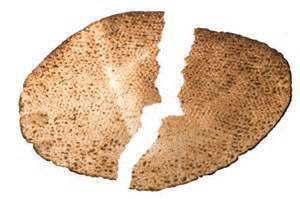 Jesus took a piece of the flat, crisp unleavened bread, retrieving it from the folds of a linen napkin where it had been wrapped. He broke it in two, the snapping sound sharp in the room. One piece was put back in the napkin, the other shrouded in another linen napkin and given to one of the participants to hide somewhere in the room. (When children were present, they would make a game of finding the hidden bread, retrieving it and resurrecting it for all to see. Before the meal could continue, they would have to find the buried bread that symbolically represented the Passover Lamb.)
Jesus and the disciples continued their Seder, the symbols and story interwoven so that with all five senses they could experience again the remarkable, supernatural history of their national redemption.
When they came to the meal portion of the Seder, Jesus again took them away from their familiar history to help them more fully understand their future destiny as disciples. He was going home; but He was also the way for all to get to His Father’s house. He’d not leave them as orphans when He left, but He’d send another Comforter just like Him to teach, remind, protect, purify and empower them for the big task ahead of them.
They listened as they chewed, trying to savor every bite in their mouths and every word in their minds. They’d be digesting the spiritual food He was feeding them for a long time. Finally the meal was over, and they gave the task of finding the buried bread to the youngest disciple, who sheepishly obliged, handing it to Jesus.
When Jesus took the bread from its linen shroud, He held it up and gave thanks. It looked like ordinary matzo bread with its many pierced holes and multiple stripes; but as Jesus broke it again and began to pass it around to them, what He said next forever changed the meaning of that bread.
“This is my body, given for you. Do this in remembrance of me.”
The bread . . . His body? Remember Him? He’d talked openly and often in recent days about what was going to happen, and they still didn’t understand. Later, the bread with holes imprinted with stripes would connect to their comprehension when they compared His pierced holy body striped with blood from scourging, and the words that Isaiah wrote centuries before came into focus as images of Calvary were laid on top of the echoes of Passover. But He was pierced for our transgressions, He was crushed for our iniquities; the punishment that bought us peace was upon Him . . . and by His wounds we are healed.
A series of blessings followed, again in familiar fashion. Blessings from the Psalms for their deliverance; for the food; for living in the land God had promised them so long ago; for Jerusalem; for the meaning of this feast.
They received the blessings, repeated them, relished again the reminders of revelation and redemption. It was time for the third cup now, the Cup of Redemption and Thanksgiving.
Jesus again turned history into destiny. He blessed it and said, “Drink from it, all of you. This is my blood, which seals the covenant. It is poured out for many for the forgiveness of sins. Mark my words, from this moment on I won’t drink of this fruit of the vine until that day when I drink it in a new way in my Father’s kingdom with you.”
He’d taken national history and used it to point to His true identity. Those memories made from a meal were the markers of His mission. The Seder had taught them to look back in gratitude for God’s saving power in the past. Jesus had turned the familiar Seder that beckoned them to look back at Passover lambs and what they had done for their nation one fateful night . . . but from now on they would never celebrate the occasion without focusing on what the Lamb of God did to bring salvation to the entire world.
Passover lamb . . . Lamb of God.
Broken unleavened bread . . . Jesus’ broken, sinless body.
Blood red wine symbolic of repeated animal sacrifices . . . rich, real blood sacrificed once for all by the Son of God.
National exodus from slavery . . . personal emancipation from sin.
Victory over Pharaoh . . . supremacy over sin, death, Satan and hell.
Promised land . . . the Father’s house.
History . . . destiny.
It would all make sense later, as so much of this memorable night in the Upper Room would. But it would take the cleansing and filling of the Holy Spirit for it to become clear to them, and He’d empower them to help others understand too.
The life lessons of that Upper Room still teach and transform us today. John says that Jesus loved His disciples to the end, showing them the full extent of His love. That lowly, loving deed expressed in all its loneliness the glory and humility of the King who led by making Himself a Servant; the Teacher who taught by living out His own lessons; the Savior who saved by making Himself the sacrifice. It is a love that keeps on loving, no matter how it is treated . . . a love that can’t be broken or defeated.
Those lessons still set the standard for every disciple of Jesus who is called to spiritual leadership. The life lessons of the basin and the towel, the bread and the blood, humility and servanthood, forgiveness in the face of betrayal, unselfish love, sacrifice and salvation.
If we do not learn those lessons, we cannot have His ministry.
When we learn them and live like our Master, our message makes sense to everyone we influence so that Jesus can turn their history into His destiny.
Roehl, Tim (2010-02-11). The Day That Changed Forever: Twenty-One Life-Changing Experiences at the Cross (Kindle Locations 779-783). Baker Publishing Group. Kindle Edition.
Categories: Studiu biblic
 Ce vezi la Florii?
  Barzilaiendan
MULTUMESC, E IMPORTANT DE CUNOSCUT CUM S AU DESFASURAT EVENIMENTELE PT. A NU FACE INTERPRETARI GRESITE
Reblogged this on La Razvi' – Razvan Mihalcea.