What is the Orthodox Church?
After the Catholic and Protestant churches, the Eastern Orthodox Church is the world’s third-largest Christian faith. As a rift between its Ukrainian and Russian branches deepen, DW looks at its history and beliefs.
The Orthodox Catholic Church is commonly known as the Eastern Orthodox Church, partly to avoid confusion with the Roman Catholic Church. It counts around 200 million members, most of them in eastern Europe, Greece and the Caucasus. Its traditional base is in modern-day Istanbul, previously known as Constantinople.
In its first thousand years, the Eastern Orthodox Church coexisted with the Rome-based Catholic Church, although relations between the two were always fraught by both theological and political differences.
These differences ultimately led to the East-West Schism, also known as the Great Schism, in 1054 A.D., in which Rome and Constantinople broke with one another. Each side blamed the other for the rupture, sometimes even accusing the other of heresy.
The religious role of Constantinople dates back to the Emperor Constantine, who in the 4th century made Christianity the official religion of the Byzantine Empire and thus of its capital. Istanbul, as that capital is now known, has remained the historic seat of Orthodoxy despite its fall to the Muslim Turks in 1453.
 Constantine was the first Roman emperor to convert to Christianity
Complex organization
The Eastern Orthodox Church is organized into self-governing (autocephalous) churches, many of which carry the title of patriarchate.
Traditionally, the leading authority in Orthodox Christianity is the Istanbul-based Ecumenical Patriarchate of Constantinople, currently presided over by Bartholomew I. Although he does not wield the power enjoyed by the pope in the Catholic Church, he is considered by his followers to be “primus inter pares” (first among equals).
This status has often been challenged by the Patriarchate of Moscow, which has many more believers than the Constantinople one. On October 15 of this year, these challenges culminated in the decision by the Moscow Patriarchate to break with the Patriarchate of Constantinople, after Bartholomew I acceded to a request by Orthodox clerics in Ukraine for independence from Moscow.
 In July 2018 Ukrainian Orthodox Church members want independence from the Moscow Patriarchate
Dogmatic differences between the churches
Papal authority: Catholics consider the pope to be Jesus Christ’s representative on earth and the successor of the Apostle Peter, who was appointed by Jesus as the first head of their Church. The Catholic Church also believes the pope to be infallible in matters of doctrine. Orthodox believers reject the infallibility of the pope and consider their own patriarchs, too, as human and thus subject to error. In this way, they are similar to Protestants, who also reject any notion of papal primacy.
Virgin Mary: The Orthodox faith rejects the Catholic doctrine of the Immaculate Conception of the Virgin Mary, in which Jesus’ mother was conceived without “original sin.” Orthodox Christians do not accept the Catholic concept of original sin, which is what makes the Immaculate Conception of the Virgin Mary seem necessary to the church of Rome. Most Protestants also reject the idea of original sin and thus the necessity of the Immaculate Conception.
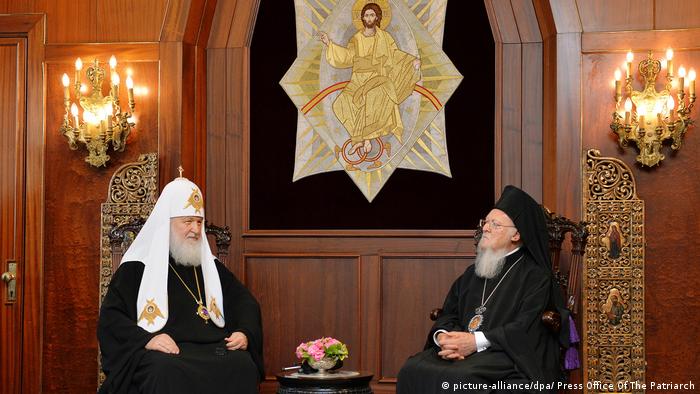
 Bartholomew has angered Moscow Patriarch Kirill with his move to grant the Ukrainian church independence from Russia’s church
Read more: The main differences between Catholics and Protestants
Holy Spirit: One of the main differences between the churches concerns the provenance of the Holy Spirit, or God’s spiritual presence on earth. It is one of the three parts of the Christian Trinity, the other two being God the Father and his human son, Jesus. The Orthodox Church believes the Holy Spirit “proceeds from God the Father,” while for Catholics and Protestants, the Holy Spirit “proceeds from the Father and the Son.” Some Orthodox believers see the Catholic/Protestant version as underestimating the role of the Father in the Trinity, while critics of the Orthodox version say it is demeaning to the Son’s role. The differences over this question were — and still are — one of the primary causes of the schism between the two churches.
Celibacy: In the Catholic Church, celibacy — the vow of abstaining from marriage and sexual relations — is obligatory for priests. Orthodox believers favor the ordination of married men. They also grant church divorces to believers in cases of adultery. Protestants also reject celibacy: 16th-century Reformer Martin Luther refused to accept that virginity was superior to marriage.
Festivals: The Orthodox Church observes the Julian calendar, so its followers celebrate religious festivals on different dates to Catholics and Protestants, who use the more recent Gregorian calendar. For example, Christmas Day, celebrated by Catholics and Protestants on December 25, is marked by Orthodox Christians around January 7.
(https://www.dw.com/en/what-is-the-orthodox-church/a-45973747)
Categories: Articole de interes general
 Barzilaiendan
Leave a comment